




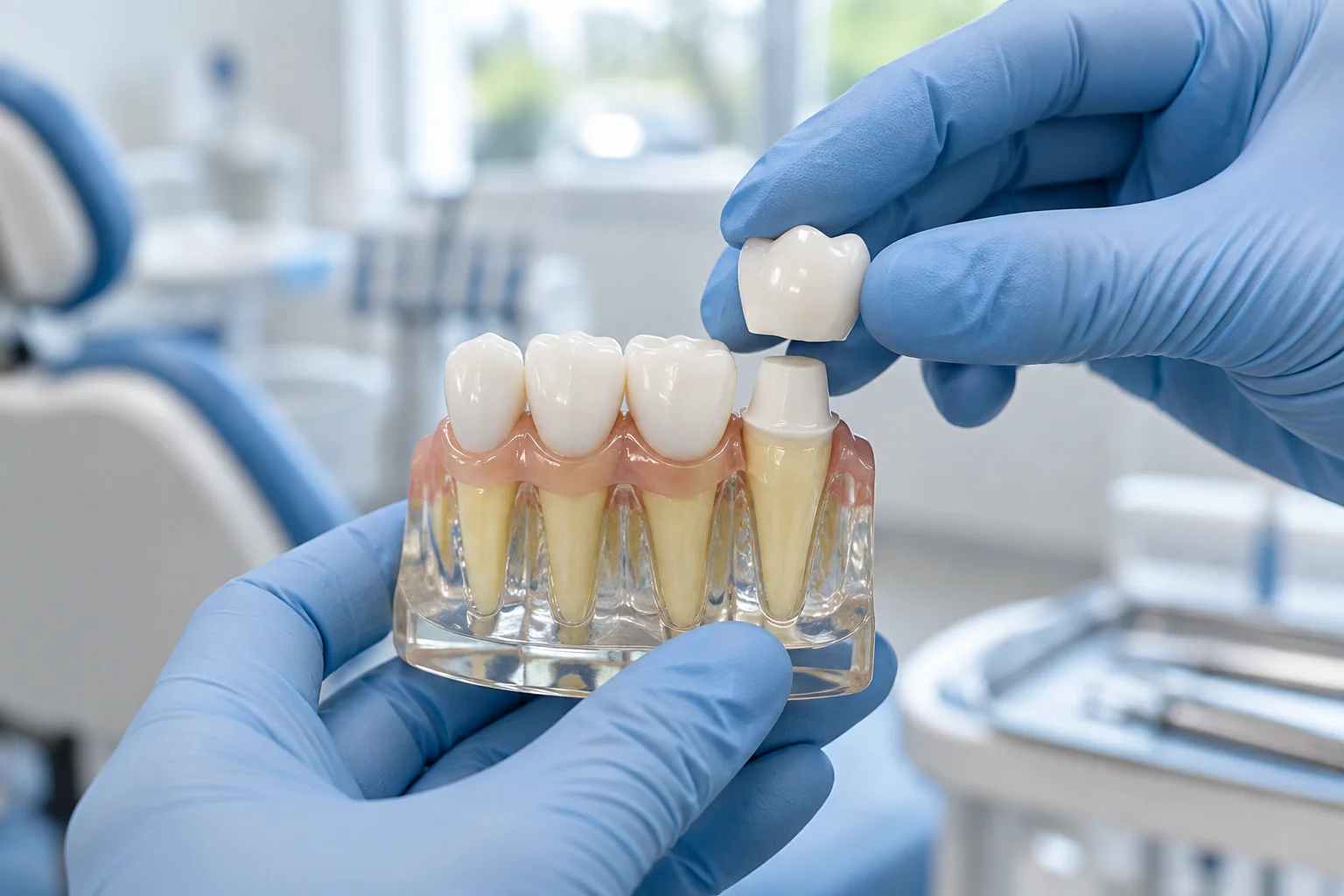
You've just had a root canal, or your dentist says you need one. Then comes the follow-up: "You'll probably need a crown afterward." It's fair to wonder whether that's necessary or just an upsell.
The short answer is that a crown after a root canal is often recommended, especially for back teeth, but it isn't automatic for every tooth. Whether you need one depends on which tooth was treated, how much healthy structure remains, and how hard that tooth works when you chew.
What a Root Canal Does (and Doesn’t Do)
During a root canal, the infected or inflamed pulp inside the tooth is removed. The space is then cleaned, shaped, filled, and sealed. According to the American Association of Endodontists, a root canal doesn't kill the tooth, and the tooth can function normally afterward.
So the root canal treats the inside of the tooth. It clears the infection and relieves the pain. It doesn't rebuild the outside: the chewing surface and the walls of the tooth that may already be weakened by decay, a large filling, or a crack. That's where a crown comes in.
Why Dentists Often Recommend a Crown After a Root Canal
A crown is a custom cap that covers the visible part of the tooth. Dentists commonly suggest one after a root canal for a few reasons.
1. To protect a weakened tooth.
Prior damage, removed tissue, and the drilling needed for treatment can all leave a tooth more fragile, and a crown adds strength to help prevent future damage.
2. To handle chewing forces.
Molars and premolars take the brunt of chewing and grinding, which is why they tend to need extra support after treatment. Front teeth bite and tear rather than grind, so they're often under less stress.
3. To seal the tooth.
A crown can seal the tooth and help prevent it from breaking after a root canal.
4. To restore appearance.
Without the pulp, a tooth may look gray or deeply stained, and a crown can restore a shade that matches the surrounding teeth.
When You May Not Need a Crown
Not every root canal tooth requires a crown. A front tooth with a small access opening and plenty of healthy structure left may do well with a bonded filling. Molars and premolars that keep a large amount of tooth and have a low risk of fracture may also be suitable for filling-only restorations.
It's also worth knowing that the research is more nuanced than "always crown." Current literature doesn't show strong evidence that crowns outperform other routine restorations for root canal treated teeth, so dentists are advised to rely on clinical judgment for each patient. That's why a good dentist looks at your specific tooth rather than applying a blanket rule.
Questions That Help Decide
- Which tooth is it? Back teeth are more likely to need a crown.
- How much tooth is left? Heavily restored or broken-down teeth usually need more coverage.
- How much force does it take? If you grind or clench, your dentist may lean toward a crown.
- Has it been restored before? A tooth with several prior restorations, including the root canal, will most likely need a crown to maintain its function and appearance.
How Soon Should You Get the Crown?
Don't wait too long. After the root canal, the tooth is typically sealed with a temporary or interim filling or cap until the final restoration is ready. A temporary cap protects the tooth while the permanent crown is made, and it's replaced at a return visit.
Timing guidelines vary by dentist and by tooth. For example, one university endodontics clinic recommends placing a crown on a back tooth as soon as possible, within three weeks of the root canal. Your own dentist will tell you the right window for your tooth. In general, a temporary seal isn't meant to last, and delaying the final restoration can put the tooth at risk of fracture or reinfection.
What to Expect When Getting the Crown
- Evaluation: Your dentist checks the tooth, the surrounding gum, and your bite, often with X-rays.
- Preparation: The tooth is reshaped so the crown fits securely. A core or build-up may be placed first if a lot of structure is missing.
- Impression or digital scan: This captures the exact shape needed for a precise fit.
- Crown placement: The final crown is checked for fit, bite, and appearance, then bonded in place.
With traditional crowns, you typically wear a temporary crown while a lab makes the final one, which means two visits.
Same-Day Crowns With CEREC
Upper East Dental Innovations uses CEREC technology and offers The Lunchtime Crown. For eligible teeth, a same-day crown can mean one visit instead of two. That can be especially helpful if you're juggling a busy Manhattan schedule and would rather not wear a temporary or return in a couple of weeks.
Whether a same-day crown is right for you depends on the condition of the tooth, your bite, and your dentist's clinical judgment. Ask about it during your consultation.
What Happens If You Skip the Crown?
If your dentist has recommended a crown and you decide against it, the tooth may be more likely to crack or fracture under normal chewing. A significant fracture can sometimes mean the tooth can't be saved. In that case, extraction and a replacement such as an implant or bridge may be the next step, which is usually more involved than a crown.
None of this means a crown is guaranteed to last forever. Any restoration can wear or need repair over time, and good home care and regular checkups matter either way.
Signs You Should Call Your Dentist Promptly
Contact your dentist soon if, after a root canal, you notice:
- A temporary filling or crown that comes loose or falls out
- A crack or chip in the tooth
- Swelling, a pimple-like bump on the gum, or a bad taste
- Pain that persists or gets worse instead of improving
- Pain when biting down
Mild soreness for a few days after a root canal is common. Severe or worsening symptoms aren't something to wait out.
Conclusion
A crown after a root canal is often the right call, particularly for molars and premolars or any tooth that has lost a lot of structure. The root canal saves the tooth from infection, and the crown helps protect it so it can keep doing its job. Still, it isn't one-size-fits-all. A front tooth with minimal damage may need only a filling. The best way to know is to have your dentist look at your specific tooth, your bite, and your restoration options.
Frequently Asked Questions
Is a crown always required after a root canal?
No. Back teeth are more likely to need one, while some front teeth with plenty of healthy structure can be restored with a filling. Your dentist can tell you what your tooth needs.
Can I wait a few months to get the crown?
It's best not to delay longer than your dentist advises. The temporary seal isn't designed to be long-term, and an unprotected tooth is more vulnerable to fracture and bacteria.
Does a root canal tooth feel different with a crown?
A well-fitted crown should feel like a normal tooth. If your bite feels high or uneven, tell your dentist so it can be adjusted.
Does a crown make a root canal last longer?
A crown helps protect the tooth from fracture, and some studies show good survival rates for crowned root canal teeth. Outcomes depend on the tooth, the quality of the restoration, and your oral hygiene.